 Part Finder
 Promote Your Inventory
Huge Changes Are Coming to the Aircraft Engine Aftermarket—but Are They?by Editor - Daniel Brindley | September 23, 2026
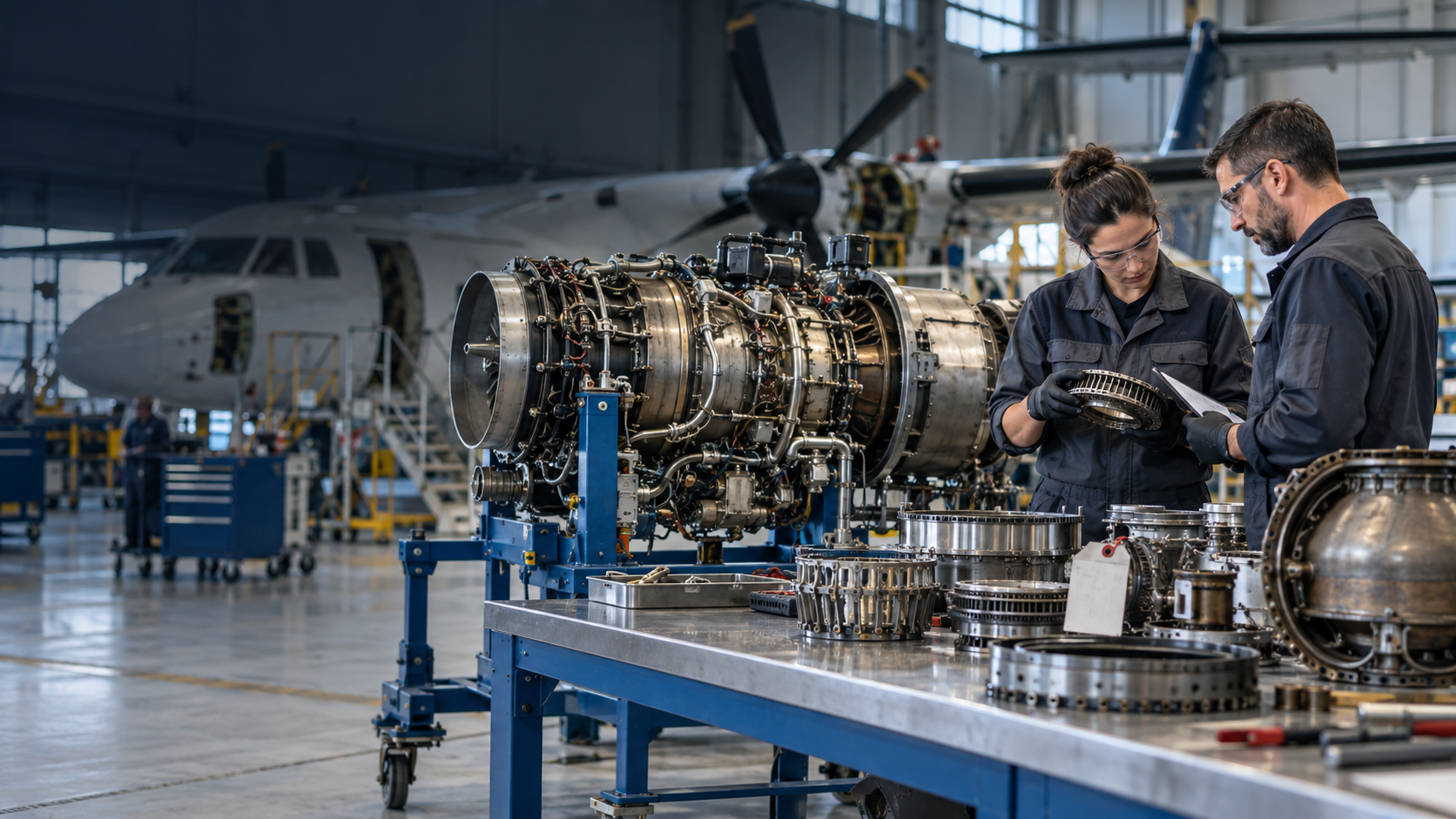
Pratt & Whitney Canada has removed contractual restrictions that may have limited the flow of engines and parts into the independent aftermarket. The change could improve USM availability and competition—but its real impact will depend on whether more material now reaches teardown companies, distributors and repair stations.
The European Commission’s antitrust investigation into Pratt & Whitney Canada’s engine business has raised a much bigger question for the aircraft-engine aftermarket: how much control should an OEM have over engines and parts after they have entered service?
The investigation centered on contractual clauses that potentially restricted authorized P&WC maintenance facilities from supplying engines and engine sections to independent aftermarket companies.

P&WC amended those clauses, removing what the European Commission described as possible obstacles preventing spare-parts suppliers from accessing critical inputs and services. The Commission subsequently closed its investigation without imposing a fine or announcing a formal finding that P&WC had broken competition law, Reuters reported on August 21.
This was not a ruling requiring P&WC or its authorized facilities to release specified quantities of engines or parts. It removed contractual restrictions that could have prevented independent companies from acquiring material for teardown and resale.
The important question is whether that contractual change will produce a meaningful change in the market.
Why the investigation matters
Pratt & Whitney Canada occupies an exceptionally strong position in the turboprop-engine market.
More than 64,000 PT6 engines have been produced, powering over 155 aviation applications, according to Pratt & Whitney Canada.
The PT6 family is used across general aviation, business aviation, agricultural aviation, utility operations and military training.
The investigation also affects the PW100 family, which powers regional aircraft including ATR and Dash 8 models. IATA has said that easier access to dismantled turboprop engines should benefit operators of these aircraft. It now wants similar competitive principles extended to the main commercial jet-engine markets, Reuters reported on September 14.
This large installed base creates a substantial long-term requirement for replacement material, repairs and engine overhauls. An engine may remain in service for decades, generating aftermarket revenue long after the original sale.
OEMs invest heavily in engineering, certification, production support and product improvement. Aftermarket revenue helps recover those investments and supports an engine throughout its operating life.
The competition question is where legitimate management of an engine program ends and unreasonable restriction of the independent aftermarket begins.
How the restrictions affected the aftermarket
Engines and engine sections acquired from operators, lessors, insurers and maintenance facilities are an important source of used serviceable material.
According to the competition concerns, P&WC’s contractual clauses restricted authorized overhaul facilities from selling certain engines and engine sections to independent teardown and USM companies.
If independent companies cannot acquire suitable assets, they cannot harvest the eligible components inside them. That can reduce the quantity and variety of USM available to distributors, repair stations and operators.
It does not mean every used P&WC part was blocked from entering the market. Material could still come from other owners and sales channels. Independent suppliers also remained active in the PT6 and PW100 aftermarket.
However, restricting access to an important source of engines could make the USM supply smaller, less predictable and more expensive.
Independent repair stations would have fewer serviceable components available. Distributors would compete for a more limited number of engines and parts. Operators would have fewer alternatives when new OEM material was expensive, unavailable or subject to long lead times.
The acquisition cost of suitable teardown engines could also rise, increasing the value of the serviceable components recovered from them.
Universal Turbine Parts made similar allegations in a separate U.S. lawsuit filed in 2024.
UTP claimed that P&WC prevented approved overhaul facilities from supplying engines and parts to independent sellers, reducing customer choice and contributing to higher prices. P&WC denied wrongdoing, and the case was resolved through a confidential settlement in December 2025.
The argument was not that the independent market had disappeared or that every operator was forced to buy new parts directly from P&WC. It was that the contractual restrictions made it harder for independent suppliers to obtain the assets needed to compete effectively.
What has P&WC agreed to change?
Based on the information made public, P&WC has amended contractual clauses that restricted access to engines and engine sections used for teardown and parts harvesting.
The change does not appear to:
Require an authorized facility to sell a particular engine or component.
Establish a minimum quantity of material that must enter the market.
Control the price at which an engine, section or part is sold.
Require P&WC to supply independent companies directly.
Guarantee access to tooling, technical data or OEM-approved repairs.
Guarantee that additional USM will immediately become available.
An authorized facility that owns an engine, engine section or inventory should retain the commercial decision over whether to sell it, who may purchase it and at what price.
The significant change is that P&WC should no longer be able to use the amended contractual clauses to prevent a sale simply because the buyer participates in the independent secondary market.
The precise wording of the revised agreements has not been published, so it remains unclear how much additional commercial freedom authorized facilities will have in practice.
The OEM relationship still matters
P&WC-authorized maintenance facilities remain closely connected to the OEM.
They may rely on P&WC for technical support, approved repair processes, tooling, replacement material, training and continued participation in its authorized network.
An approved facility may therefore be contractually free to sell an engine into the secondary market while remaining cautious about damaging its wider commercial relationship with P&WC.
This could limit the immediate impact of the amendments. Removing a restriction makes additional transactions possible, but it does not compel authorized facilities to pursue them.
Could USM availability increase and prices fall?
If more PT6 and PW100 engines and sections reach independent teardown companies, the supply of eligible serviceable material should increase.
That would give distributors and independent repair stations more sourcing opportunities. Operators could gain more alternatives to new OEM material, particularly when parts are unavailable or subject to long lead times.
Additional USM could also reduce pressure on new-part supply by allowing serviceable material to support existing fleets while newly manufactured components are directed toward applications where used material is unavailable or unsuitable.
IATA estimates that shortages of engine parts and maintenance capacity cost airlines almost $6 billion last year. It argues that repairing and reusing more existing material could help relieve pressure on new-part supply, according to Reuters.
However, lower prices are not guaranteed.
The value of USM depends on demand, condition, remaining life, traceability, repair history and the number of suitable engines available for dismantling. Strong demand and limited repair capacity could keep prices high even if contractual access improves.
The most realistic outcome is a gradual improvement in availability for certain parts, accompanied by greater competition and some pricing pressure. A sudden flood of inexpensive PT6 and PW100 material is unlikely.
Could this spread to the commercial jet-engine market?
The P&WC case concerns turboprop engines, but IATA sees it as a possible precedent for the much larger commercial jet-engine aftermarket.
Jet-engine parts are expensive, repair capacity remains constrained, and airlines continue to search for alternatives to new OEM components and long delivery times.
If similar contractual restrictions exist in major jet-engine programs, the P&WC outcome gives airlines and independent suppliers a regulatory example they can use when challenging them.
It does not automatically change the aftermarket policies of GE Aerospace, CFM International, Rolls-Royce or Pratt & Whitney’s large commercial-engine business. Each manufacturer uses different contracts, licensing arrangements and support networks.
Any wider change would require scrutiny of the specific practices used within those programs.
So, are huge changes coming?
Possibly—but not overnight.
The closure of the EU investigation does not require anyone to sell an engine, dictate aftermarket prices or remove P&WC’s technical and commercial influence over its engine programs.
It removes a contractual obstacle that may have restricted the movement of engines and engine sections into the independent aftermarket.
The real test will be whether more material now reaches independent teardown companies. If it does, operators could gain more sourcing options, repair stations could obtain parts more quickly, and competition could begin to ease pricing pressure on scarce components.
The immediate change is contractual. Its real significance will depend on whether the material starts to move.
Sources
EU closes antitrust probe into RTX’s Pratt & Whitney — Reuters, August 21, 2026
Airlines urge more competition on used jet-engine parts — Reuters, September 14, 2026
Pratt & Whitney Canada marks 60 years of the PT6 engine family — RTX
Pratt & Whitney hit with aircraft-engine antitrust lawsuit — Reuters, May 13, 2024
Pratt & Whitney settles antitrust lawsuit over engine sales — Reuters, December 30, 2025