 Part Finder
 Promote Your Inventory
FAA Form 8130-3 – Authorized Release Certificate, Airworthiness Approval Tagby Editor - Daniel Brindley | August 31, 2026
From wartime export tag to global traceability standard — what the FAA 8130-3 covers, what it can't do, and how it compares to its EASA and TCCA counterparts.
What the tag can and can’t certify, how it stacks up against EASA Form 1 and TCCA Form One, and how to spot a forged one.
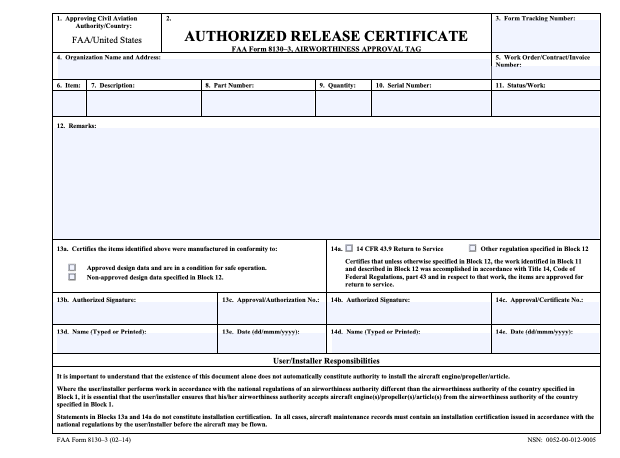
This article takes a look at certain elements of the FAA 8130-3. A copy of the 8130-3 is shown in the accompanying image, and we’ll reference specific blocks on it throughout.
What is an FAA 8130-3?

FAA Form 8130-3 sits under 14 CFR Part 21 – Certification Procedures for Products and Articles.
The FAA 8130-3 is used to certify that an aircraft part or product is in acceptable condition for safe operation within the United States or one of its global partners in aircraft accountability. More detail below.
Origins
The 8130-3 started life as an export tag (originally called FAA Form 186), used primarily for aircraft, engines, and major assemblies. As the aftermarket for parts (for export) grew, the FAA extended the tag to cover component parts too.
That expansion was driven first by manufacturers wanting to export piece parts for the aftermarket, then by parts distributors who wanted the same certification when exporting. For a stretch, the FAA actually ran two versions in parallel — an export tag and a separate domestic tag — before folding them into a single standard 8130-3 format.
The use of the 8130-3 also helped separate good parts from bad ones. As the tag became more popular, it became more important as a traceability record, both domestically and for export.
The most current version of the 8130-3 can be found here: https://www.faa.gov/forms/index.cfm/go/document.information/documentID/186171
Main purposes of the FAA 8130-3
The form may constitute a statement from the FAA that a new product, article, or part conforms to its design and is in a condition for safe operation.
The form may be used to return to service a used product or article following inspection, maintenance, or alteration — for example, an overhauled or repaired part.
The form may be used when exporting products or parts to meet the requirements of bilateral agreements between the United States and other countries. This includes used parts — for example, parts being imported into the EU from the USA — which would need a dual-release FAA 8130-3.
In all cases, the form is used to promote the identification and traceability of products and parts throughout the global aviation system.
What an FAA 8130-3 cannot be used for
FAA Form 8130-3 is not a delivery or shipping document, and it shouldn’t be used for administrative purposes between two parties — for example, as a receipt.
FAA Form 8130-3 may not be issued by organizations or individuals other than those approved or authorized by the FAA, within the scope of that approval or authorization.
Aircraft are not to be released using FAA Form 8130-3.
FAA Form 8130-3 does not constitute approval to install the product or article on a particular aircraft, aircraft engine, or propeller. It does, however, help the end user determine the airworthiness approval status of a product or article.
A mixture of production (new parts) and maintenance-released products (repaired or overhauled parts) is not permitted on the same FAA Form 8130-3.
A mixture of products and parts released against approved and non-approved design data is not permitted on the same FAA Form 8130-3.
FAA Form 8130-3 cannot be used to export a prototype product or article.
Counterfeit parts and precautions when using an FAA 8130-3
The FAA 8130-3 is an open, downloadable form available on the FAA website and can be filled out anonymously. So if a fraudulent manufacturer wanted to move counterfeit parts, it would be easy enough to fill out an 8130-3 to try to legitimize them.
Fortunately, there’s good traceability built into the form — signature, organization address, work order numbers, and part serial numbers. If any of it’s forged, it can be checked.
An FAA Aviation Safety Inspector (ASI), for instance, or an authorized representative of a Production Approval Holder (PAH), are among the small, qualified group of people who can sign an 8130-3. Their approval and authorization number is stated right next to their signature and name, in Block 13c — easy enough to trace.
Bilateral Agreements
As mentioned, the 8130-3 is used by global partners in aircraft accountability. This works through bilateral relations, where countries like the EU (EASA) and Canada (TCCA) recognize one another’s airworthiness certifications — respecting each other’s aviation standards, cutting duplicated work, and streamlining the process. These agreements are what keep parts moving efficiently around the world.
EASA and TCCA Certs
Both forms serve the same purpose as the 8130-3 and are nearly identical, with a few subtle differences.
**EASA Form 1 ** is always required for components. FAA Form 8130-3, by contrast, isn’t mandatory for a purely domestic (U.S.-to-U.S.) shipment — the FAA only recommends it there. It becomes a requirement once export or a bilateral agreement is involved.
**TCCA Form One ** is required for parts, with the exception of standard and commercial parts — reportedly because those are manufactured to established industry standards and their compliance is traceable back to the manufacturer that way. (Worth confirming this exception against a current TCCA advisory circular before publishing — I wasn’t able to independently verify it.)
TCCA Form One
TCCA Form One, or Authorized Release Certificate, is a document used by Transport Canada (TCCA) to certify the airworthiness of aeronautical products — including parts and components — after maintenance or manufacturing. It’s recognized by EASA and other international aviation authorities.
EASA Form One
EASA Form 1, or Authorized Release Certificate, is a document used within the European Union Aviation Safety Agency (EASA) framework to certify that a product, part, or component has been manufactured or maintained in accordance with approved design data, confirming it’s airworthy.
FAA 8130-3 and Dual Release
When parts are being exported, the bilateral agreement makes the dual-release process straightforward. The FAA-authorized organization or repair station simply ticks the box in Block 14a, “Other regulation specified in Block 12.” Block 12 then carries a statement along these lines:
“Certifies that the work specified in block 11⁄12 was carried out in accordance with EASA Part 145 and, in respect to that work, the product/article is considered ready for release to service under EASA Part 145 Approval No. EASA.145.XXXX.”
Where “XXXX” is the unique identifier assigned to that approved maintenance/repair organization.
Difference between a Certificate of Compliance (C of C) and an FAA 8130-3
A C of C is typically used for parts or materials that aren’t regulated under specific airworthiness certification — though they still have to meet FAA standards of compliance in manufacturing. Standard hardware, like a fastener, might only come with a C of C.
Manufacturers of aircraft parts, components, and materials must be FAA-certified if their products are intended for use in aviation. Manufacturers are subject to FAA audits and have to maintain certain quality systems.
A C of C may include language like: “Seller certifies that the item(s) on this order were manufactured and inspected with [OEM Name] – FAA Approved Quality System.”
I’ve also seen this from a distributor: “Where item/s or service/s have been procured from an FAA-approved supplier, the seller further confirms, attest or certifies, or has on file, applicable supplier certifications.”
I’d ask for additional information where possible — date, signature, batch number, and/or serial or lot numbers. That all helps with traceability. Remember: a C of C, unlike an FAA 8130-3, isn’t on its own sufficient for airworthiness certification.
Conclusion
We hope you’ve enjoyed this refresher on the well-documented FAA 8130-3 airworthiness approval tag. Always check with your respective aviation authority for the most current information — standards, rules, and procedures change.