 Part Finder
 Promote Your Inventory
Can an A&P Maintain an Electric Airplane? What the Pipistrel Velis Changes—and What It Doesn’tby Editor - Daniel Brindley | August 26, 2026
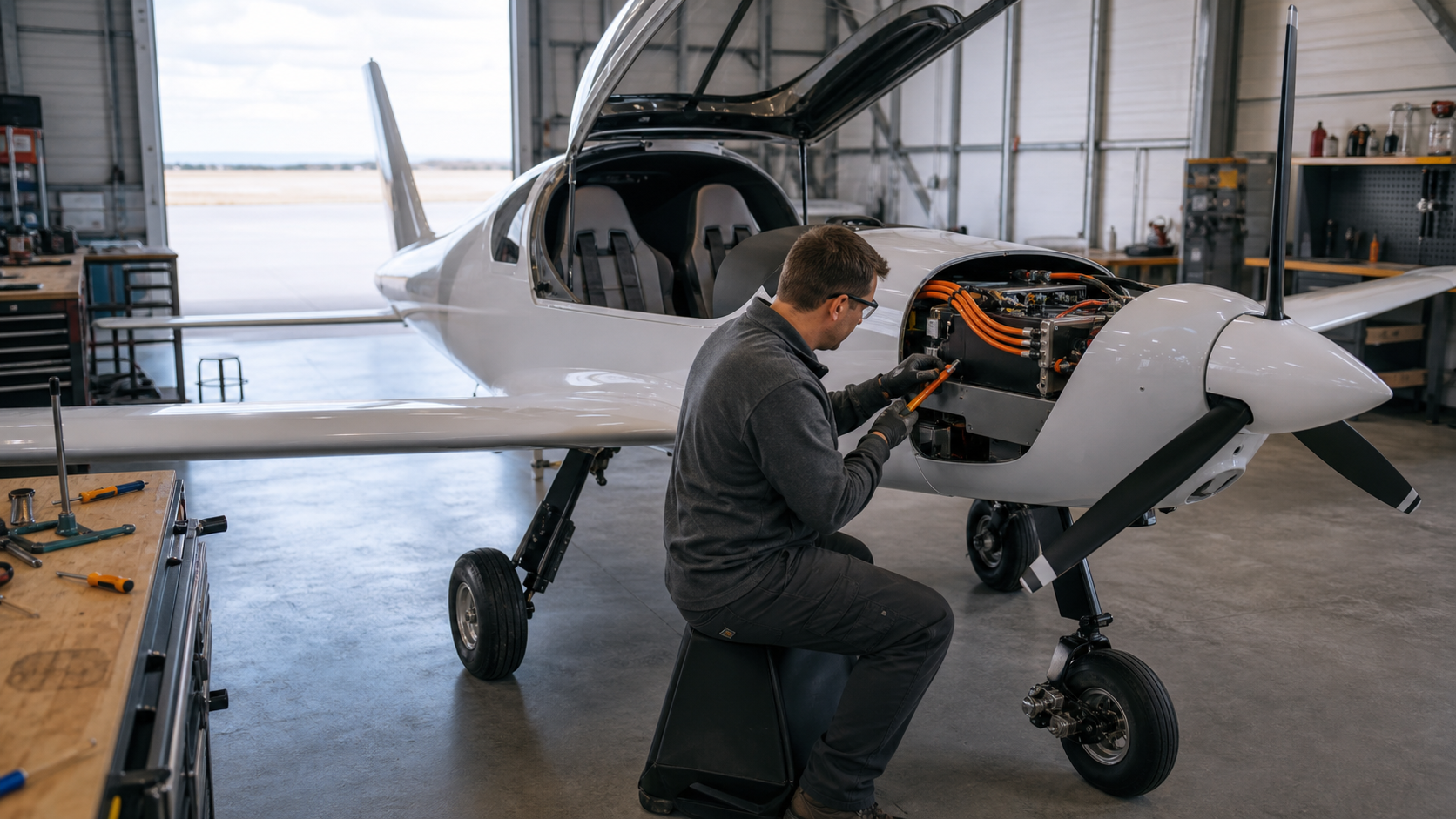
The Velis removes much of the familiar piston-engine workload, but its high-voltage powertrain brings a new set of training, tooling, data and support requirements.
Pull the cowling from a typical piston trainer and an A&P knows what to expect: cylinders, ignition, exhaust, fuel lines, oil plumbing and the usual evidence of heat, vibration and leakage. Open the same area on a Pipistrel Velis Electro and much of that familiar engine work has disappeared.
In its place is a 345-volt propulsion system built around two batteries, a liquid-cooled electric motor, a power controller, high-voltage wiring and software-driven monitoring.

The Velis still has tires to wear, brakes to service, flight controls to inspect and a propeller sitting out front. It also remains a certificated aircraft with scheduled inspections, maintenance records and return-to-service requirements. What changes is the knowledge, tooling and technical access required when the work moves beyond the conventional airframe and into the electric powertrain.
That raises a practical question for GA shops: can an A&P maintain an electric airplane?
The short answer is yes—but the certificate alone doesn’t qualify a mechanic for every task on the aircraft.
The A&P certificate is the starting point
The FAA confirms that a certificated mechanic may perform maintenance and inspections on light-sport category aircraft. That includes airplanes powered by electric motors.
The mechanic must still understand the manufacturer’s current instructions and be competent to perform the particular task. Under the FAA’s current light-sport guidance, a mechanic can’t approve work for return to service simply because the certificate says Airframe and Powerplant. The person must have previously performed the work satisfactorily, demonstrate the necessary ability or work under appropriate supervision. FAA light-sport repairman guidance
An appropriately rated light-sport repairman with a maintenance rating may also perform maintenance and inspections within the privileges of that certificate.
For the US Velis fleet, the applicable framework includes Parts 43, 65 and 91, the aircraft’s operating limitations, current manufacturer maintenance data and any applicable safety directives or airworthiness requirements. A Velis used for flight instruction will also have the applicable inspection requirements associated with that operation.
Part 135 does not automatically apply. Flight instruction is generally conducted under Part 91, even when the school charges for the aircraft and instructor. Part 145 doesn’t automatically apply either. A properly authorized individual mechanic can perform routine maintenance without the shop holding a repair-station certificate.
A Part 145 repair station could become involved in specialized component work, but its certificate alone wouldn’t authorize every Velis task. The ratings, capability list, technical data, tooling, training and test equipment would still have to cover the work being performed.
Owners and operators face similar limits. They may perform eligible preventive-maintenance tasks when the regulations and aircraft documentation allow it. Ownership isn’t blanket authority to disconnect high-voltage components, open a battery or clear propulsion faults.
Much of the airplane remains familiar
The Velis is electric, but it hasn’t stopped being a light airplane.
An experienced GA technician will recognize plenty of the inspection:
- Tires, wheels and wheel bearings
- Brake pads, discs, lines and fluid
- Fixed landing gear and its attachments
- Flight controls, hinges, pins and cables
- Pitot-static equipment and instruments
- Avionics, antennas and electrical equipment
- ELT and restraint systems
- Composite airframe condition
- Propeller condition and attachment
- General lubrication, security and wear
The Velis Pilot’s Operating Handbook calls for a complete inspection every 100 hours in addition to the annual requirement under the applicable operating rules. Its servicing information covers tires, brakes and the propeller, while the preflight inspection includes the landing gear, tire condition, brake wear, fluid leakage and evidence of overheating. Velis Pilot’s Operating Handbook
The wheels and brakes aren’t connected to the electric motor, so there’s no automotive-style regenerative braking. They absorb landing and taxi energy in the usual way. A training aircraft doing repeated circuits may still consume tires and brake material at a healthy rate.
The real overlap with a Cessna, Piper or other piston trainer is therefore on the airframe side—not inside the powerplant.
What disappears with the piston engine
Electric propulsion removes a substantial list of familiar maintenance items:
- Engine oil and filter changes
- Spark-plug inspection and replacement
- Magneto maintenance
- Compression checks
- Cylinder and valve work
- Exhaust-system inspection
- Carburetor or fuel-injection maintenance
- Fuel pumps, filters and engine fuel lines
- Conventional piston-engine overhaul
There’s also no engine warm-up in the usual sense and considerably less powerplant vibration. Pipistrel markets the Velis on low operating and maintenance costs, although it does not publish enough detailed fleet data to make a complete like-for-like cost comparison with a piston trainer. Pipistrel Velis Electro
Fewer moving parts should reduce routine propulsion work. But “less maintenance” shouldn’t be confused with “simple maintenance.” The workload has moved.
Where the electric learning curve starts
Instead of troubleshooting fuel, ignition and combustion, the mechanic may be dealing with:
- High-voltage isolation
- Battery state of health
- Cell-voltage differences
- Battery temperature
- High-voltage cables and connectors
- Contactors and interlocks
- Motor-controller or inverter faults
- Electric-motor sensors and bearings
- Battery and motor cooling systems
- Electrical insulation faults
- Software and configuration records
The Velis propulsion display gives the crew and maintenance organization considerably more than a fuel-gauge equivalent. It reports state of charge and separate state-of-health values for the two batteries, along with temperature, minimum and maximum cell voltage, pack voltage, current and balancing status.
State of charge tells the operator how much energy is presently available. State of health represents the battery’s declining capability as it ages. An aircraft may show a full charge while having less usable capacity than it had with new batteries.
That directly affects the training mission. Researchers at the University of Waterloo reported fewer available circuits as the Velis batteries’ indicated state of health declined. They also found that indicated battery condition can move with temperature, complicating a simple hours-or-cycles view of battery life. University of Waterloo
Pipistrel’s exact state-of-health calculation and the current US removal criteria aren’t publicly explained in enough detail to quote a universal limit. Published figures also vary across battery generations, jurisdictions and aircraft approvals. Any shop or buyer evaluating battery life needs the current part number, Airworthiness Limitations Section and technical-document revision—not a generic number taken from an older aircraft.
How far can an independent shop go?
This may be the most important commercial question for a maintenance provider.
Pipistrel maintains a controlled Technical Publications Portal for the Velis maintenance manual and service information. The company directs users to customer support for access credentials. That confirms the data is available through a managed system, but it doesn’t establish that any independent mechanic automatically receives every document, diagnostic function or software tool.
Pipistrel also offers dedicated five-day VSW 128 Velis Electro technical training. The current course covers electric propulsion, aircraft systems, maintenance procedures and real-world diagnostics. Pipistrel says attendees receive a certificate of completion authorizing them to work on its aircraft in accordance with their qualifications and local regulations. Pipistrel technical training
A previously published Pipistrel training program provides a useful view of how the work has been divided. It covered the electrical harness, motor, cooling system, motor controls and engine-indicating system. Work inside the batteries and certain component maintenance remained with Pipistrel. Trained personnel could remove line-replaceable units, prepare them for shipment and reinstall replacements. Velis maintenance-training program
That document dates from 2022 and was prepared around European maintenance arrangements, so Pipistrel should confirm how the current policy applies to US A&Ps. Even so, it points toward a familiar modern support model: the local shop handles the aircraft, diagnostics and LRU changes while internal work on proprietary high-voltage components stays with the manufacturer or a designated facility.
In practical terms, an independent shop would need to determine:
Which tasks its personnel are trained to perform Whether Pipistrel training is required for those tasks Which manuals and service bulletins it can access Which insulated tools and protective equipment are required Whether diagnostic software requires credentials Which faults can be cleared locally Which components must be returned to Pipistrel Whether battery removal requires special lifting or shipping equipment Being legally permitted to perform maintenance isn’t the same as having a complete Velis capability.
Charging belongs in the maintenance conversation
Charging may be handled by pilots or line personnel, but it has a direct effect on the aircraft’s most expensive propulsion component.
The Velis uses an external approved charger and liquid-cooled batteries. Charging time depends on battery condition, temperature and the starting state of charge. Operators must monitor the process and follow the applicable limits rather than treat the aircraft like a car left plugged in overnight.
The POH instructs operators to keep flammable liquids away, position charging cables clear of other operations, keep a long-range water-type extinguisher nearby and remain in the vicinity of the aircraft. Charging should not be left completely unattended.
If smoke or fire appears, the procedure is to stop charging, remove the heat source if possible, evacuate and use copious water to delay fire propagation. The handbook warns that lithium battery fires are self-sustaining and that smoke is hazardous. Following a battery-fire event, the aircraft should remain under surveillance for at least 24 hours because delayed thermal runaway or late cell ignition remains possible.
Those instructions address immediate operations. A maintenance facility still needs its own plan for a damaged or suspect battery: isolation, outdoor quarantine, emergency-service coordination, safe movement and compliant shipping. The public POH doesn’t provide a complete hangar-design or battery-quarantine standard.
Software is now an airworthiness item
The Velis also shows how maintenance records are moving beyond installed hardware.
In 2024, EASA issued an airworthiness directive requiring electrical-power software and data-recording upgrades on affected Velis aircraft through specified Pipistrel service bulletins. EASA AD 2024-0246
That isn’t an owner clicking “update” on a consumer device. The correct software version, installation method, aircraft applicability and maintenance record all matter.
For a shop building electric-aircraft capability, software access may prove just as important as insulated tools. The technician must know which faults can be reset, which events require manufacturer review and who is authorized to load a new configuration.
A different kind of GA maintenance
The Velis doesn’t make the A&P obsolete. It makes the limits of general qualification more visible.
The airframe still needs the inspection judgment that GA mechanics already bring to the hangar. Tires wear. Brakes heat up. Landing gear takes training loads. Controls, structures, avionics and propellers still require attention.
The electric side adds a different discipline: high-voltage safety, battery health, liquid cooling, fault data, software control and closer access to manufacturer support. Some piston-engine work disappears, but the most expensive components may be less open to field repair and more dependent on approved diagnostics and exchange support.
For shops, the immediate market remains small. Pipistrel produced its 100th Velis in 2024, and the US support network is still developing. The company has since added US field representatives and a Wichita parts warehouse, but it does not publish a current count of US facilities qualified for each level of Velis work.
The opportunity today may be limited. The learning curve is not.
As more electric trainers and larger electric or hybrid aircraft enter service, maintenance providers will have to decide where their capability stops: conventional airframe work, trained electric line maintenance, propulsion-system diagnostics or full component support.
An A&P can maintain an electric airplane. The better question is how much of it—and what training, tooling and manufacturer access the shop needs before signing the aircraft back into service.