 Part Finder
 Promote Your Inventory
Beyond the Tag: The Hidden Export Risks in Your Aftermarket Inventoryby Editor - Daniel Brindley | July 7, 2026
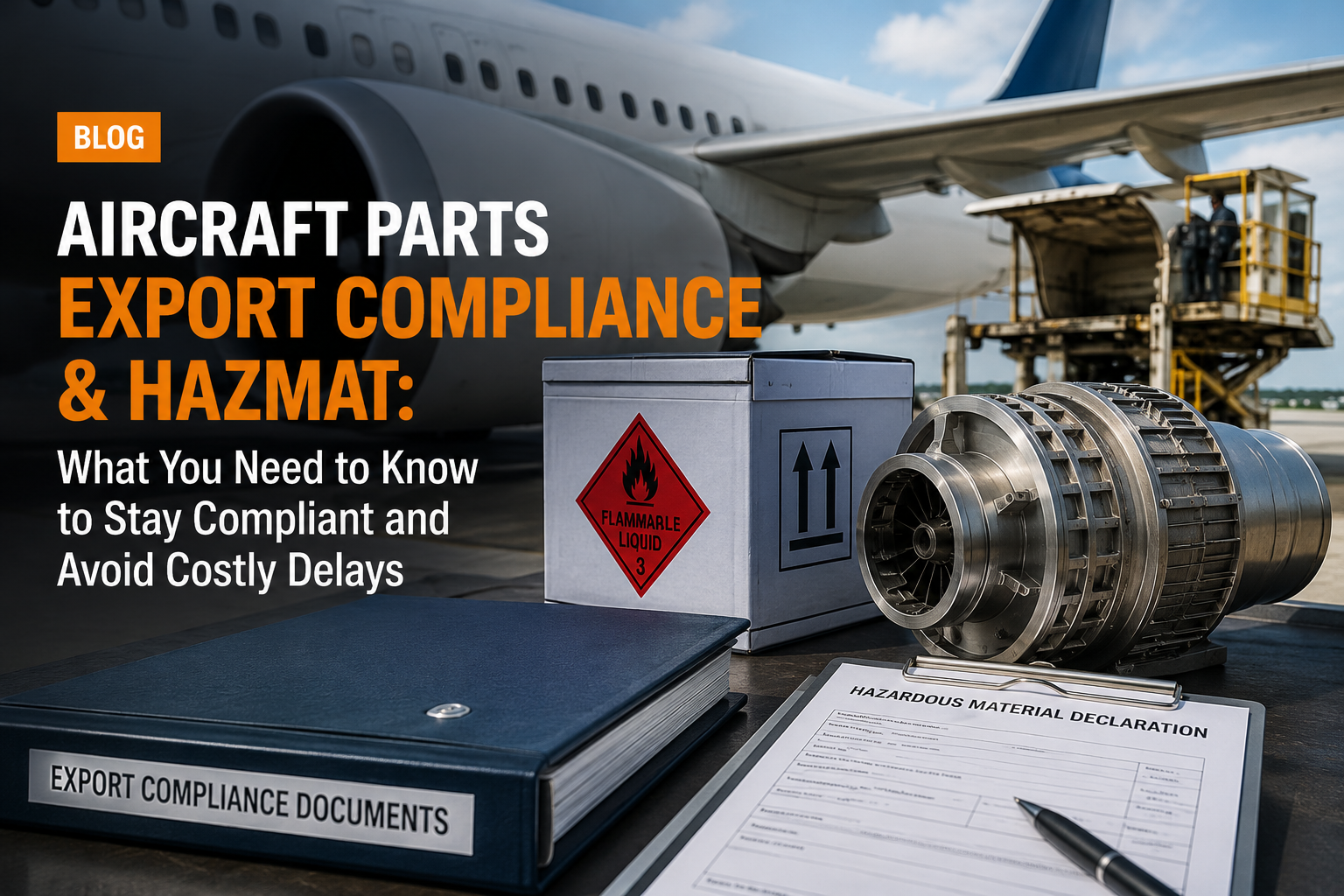
In today’s volatile regulatory environment, a major threat to your transaction speed and bottom line isn't just negotiating the price—it’s export control compliance. If you are moving high-demand components across borders, a mistake in your export licensing strategy can lead to delayed shipments, seized inventory, and astronomical federal fines.
Beyond the Tag: The Hidden Export Risks in Your Aftermarket Inventory
For most independent parts distributors and brokers, sourcing is all about speed and numbers. When an RFQ hits your inbox, the transaction comes down to three main drivers: the condition of the part, the price, and the physical location for shipping lead times. If the 8130-3 or EASA Form 1 matches the required condition and the numbers work, the deal moves forward.
But there is a dangerous trap waiting for parts companies that stop their due diligence at the basic parameters of the tracking tag.

In today’s volatile regulatory environment, a major threat to your transaction speed and bottom line isn’t just negotiating the price—it’s export control compliance. If you are moving high-demand components across borders, a mistake in your export licensing strategy can lead to delayed shipments, seized inventory, and astronomical federal fines.
The Flashpoint: Explosive Cartridges & Hazmat Components
The absolute highest risk category for an everyday aviation parts broker involves components that contain energetic materials—specifically explosive cartridges (squibs) used in:
- Engine and cargo fire extinguishing bottles
- Emergency evacuation slide inflation systems
- Life raft deployment mechanisms
- Oxygen generators
Because these parts contain actual explosives, they are heavily controlled under U.S. export laws. Treating a fire bottle cartridge like a standard bracket or hydraulic valve is an express lane to a massive compliance violation.
ITAR vs. EAR: The Jurisdiction Trap
The biggest compliance hurdle is figuring out which government agency controls the part:
- The Commerce Department (EAR): Most standard commercial aircraft cartridges fall under the Export Administration Regulations (EAR) and are classified under specific Export Control Classification Numbers (ECCNs) like
1A004or9A610. Depending on the destination country, these might ship under “No License Required” (NLR) or require a specific Commerce license. - The State Department (ITAR): If that exact same cartridge was “specially designed” or modified for a military platform, it is governed by the International Traffic in Arms Regulations (ITAR) under the U.S. Munitions List (USML). Shipping an ITAR item internationally without a State Department DSP-5 license is a federal crime.
The Broker’s Golden Rule: Never guess. Before you ship an explosive cartridge or hazardous component internationally, you must request the ECCN or ITAR classification from the OEM or a verified compliance database. If the part doesn’t have a clear classification logged in your system, do not clear it for international export.
What Happens When Trade Friction Hits Your Shipping Dock?
Even for non-hazardous parts, international trade policies dictate whether your shipment will get caught at the border or hit with unexpected fees that wipe out your margin.
The baseline rules of international trade are constantly shifting. Following major legal challenges and high-level summits, the industry is navigating a rolling series of global surcharges and newly proposed “30 for 30” trade councils. If you are importing or exporting parts to or from heavily restricted regions, the math changes overnight.
Consider how a standard entry is penalized using the Harmonized Tariff Schedule (HTS):
HTS Code 8411.11.40.00 →Turbo-Jets (Thrust ≤ 25 kN)
If a foreign-manufactured or foreign-repaired turbine coming into your warehouse is valued at $2,000,000, a standard 35% tariff slaps an immediate $700,000 tax on that single import before it ever reaches your shelf.
The “Repaired In” Catch
While condition and price rule the deal, the location where a part was repaired can trigger unexpected customs costs. Under customs law, if an American-made part is sent to an overseas MRO facility for an overhaul, the value of that repair work can be heavily taxed when re-entering the country depending on that country’s current tariff standing.
Furthermore, if a U.S. distributor drop-ships a part directly to a customer in China, but that component was originally manufactured or repaired in France, the Chinese customer is on the hook for China’s specific tariff rate on French-origin goods.
The Parts Broker’s Compliance Checklist
To keep your cash flow moving and your shipping dock clear, independent parts companies must implement three tactical plays right now:
1. Build an “Export Control” Gate in Your ERP
Do not allow your shipping team to generate an international waybill for any part number flagged as hazardous or energetic (like squibs) without an automated system block. Force a compliance review to confirm if an export license or an official ECCN declaration is required for that specific destination.
2. Weaponize “Pre-Tariff” Stock
Look closely at your current inventory. Components purchased, tagged, and logged in your warehouse before the latest round of global trade penalties represent a massive competitive advantage. You can hold firm on market-rate pricing and swallow the tariff cost for your international customers as a powerful customer-retention tool, or undercut tariff-inflated competitors to flip the inventory fast.
3. Trust the Document, Verify the Restriction
While a clean 8130-3 or EASA Form 1 verifies the condition of the part, your compliance officer must look at the restricted party lists. Even a completely benign, non-licensed commercial part cannot legally be sold to companies or individuals listed on the BIS Entity List or the OFAC Specially Designated Nationals (SDN) list.
The Road Ahead
The aviation aftermarket moves at a lightning-fast pace, and transaction speed is everything. However, moving fast without looking at export licenses and country-of-origin penalties is a massive gamble. The parts companies that protect their shipping lanes by locking down their ECCN data for critical components will be the ones positioned to safely win market share, while slower, less-compliant competitors get tied up in customs detentions.